
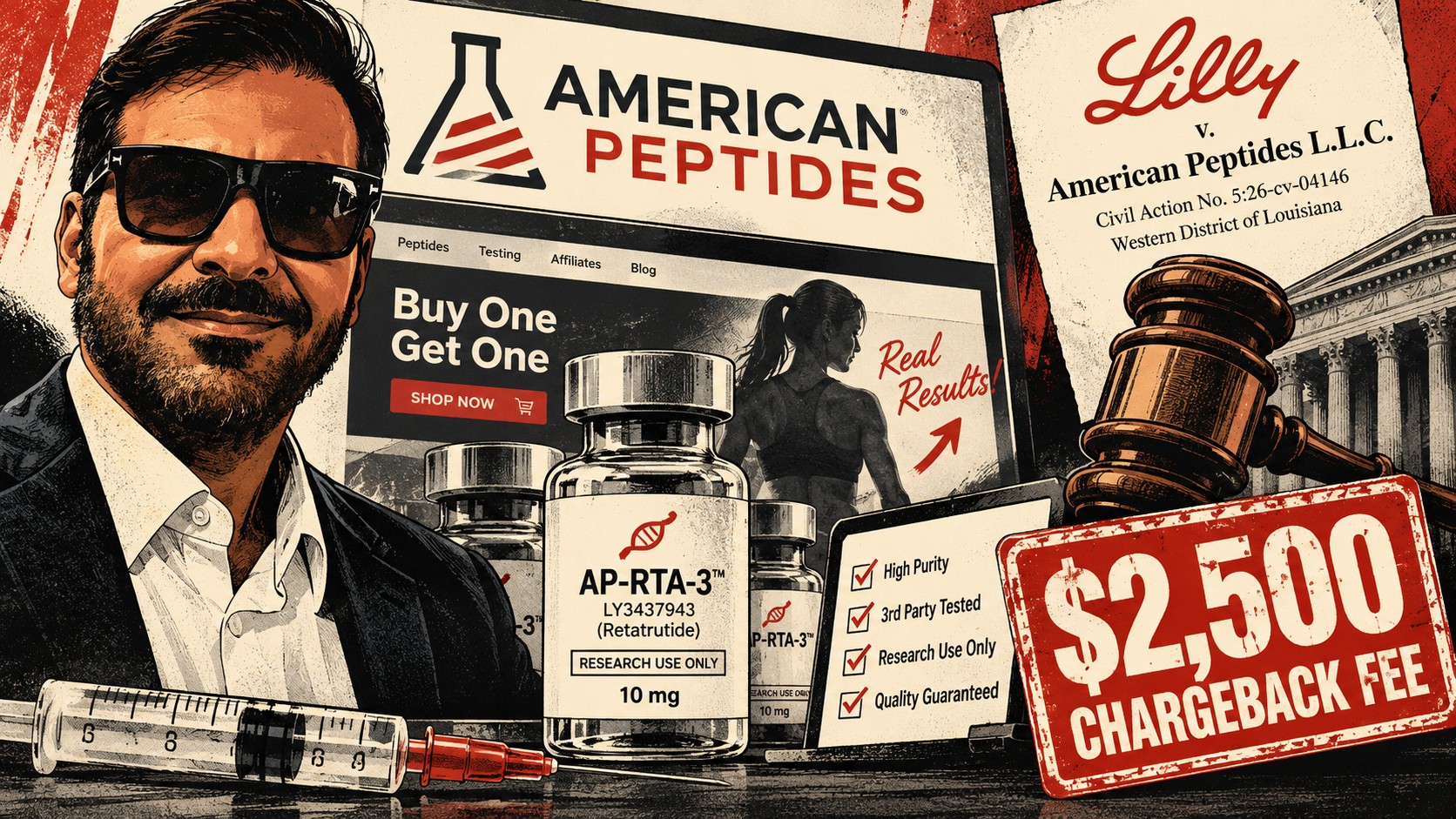
American Peptides has apparently discovered the secret to modern online commerce: dress an aggressive retail operation in a laboratory coat, surround it with scientific terminology, and hope nobody reads the legal fine print.
The Shreveport-based peptide seller presents itself as a sophisticated supplier of high-purity research compounds.
Its website advertises independent testing, extensive quality controls, domestic production, certificates of analysis, and scientific expertise.
The marketing practically smells of freshly sterilized stainless steel.
But examine the operation more closely, and a different picture emerges.
The company is currently defending its position in a federal lawsuit brought by pharmaceutical giant Eli Lilly over alleged marketing and sales of purported retatrutide, an experimental drug that has not received FDA approval.
Its published terms contemplate a $2,500 chargeback penalty under certain circumstances.
Its various refund and cancellation policies don’t consistently describe when customers can cancel their orders.
And its product marketing contains claims about testing and purity that deserve closer examination against the actual documentation provided.
These aren’t hypothetical concerns dreamed up by someone who dislikes the peptide industry.
They come from American Peptides’ own website, public court records, and federal regulatory guidance.
Let’s examine what the company is selling, what it promises, and what happens when those promises encounter a little scrutiny.
Welcome to the Laboratory. Your Buy-One-Get-One Deal Is Waiting.
The first thing American Peptides wants visitors to understand is that its products are not intended for human consumption.
The website requires visitors to acknowledge that they are at least 21 years old and agree to use the products exclusively for laboratory research.
The company says its products are not drugs, supplements, foods, cosmetics, or treatments.
Fair enough.
There is a legitimate market for scientific reference compounds. Researchers need analytical materials, and laboratory suppliers can lawfully sell many substances for legitimate research purposes.
But American Peptides doesn’t look much like the stereotypical laboratory supply catalog.
Its storefront advertises:
- Buy-one-get-one promotions on selected peptides.
- Discounted subscription purchases with recurring deliveries.
- Free shipping above a specified order amount.
- Military and first-responder discounts.
- Affiliate commissions reaching 35%.
- Product bundles and promotional campaigns.
During our October 25, 2026, review, the company was promoting a Halloween-themed buy-one-get-one offer on selected peptides.
A holiday sale does not establish that a product is being marketed for human use. Scientists are perfectly capable of appreciating discounts.
But the combination is certainly worth examining.
The website is simultaneously presenting itself as a restricted laboratory supplier and operating an elaborate direct-to-consumer-style marketing system.
The important question is whether its actual customer screening and marketing practices meaningfully enforce the scientific-use restrictions it advertises.
And that question becomes considerably more interesting when we look at the company’s best-selling product.
Retatrutide by Another Name Is Still Retatrutide
American Peptides prominently advertises a product called AP-RTA-3™.
The website identifies it as compound LY3437943, a synthetic peptide acting on GIP, GLP-1, and glucagon receptors.
LY3437943 is the developmental identifier for retatrutide, the experimental molecule being studied by Eli Lilly.
The product is advertised in several vial sizes, with pricing starting at $105.
The company labels it a research reference material and states that it is not approved for human consumption.
This is not a situation where customers must conduct an elaborate chemical investigation to discover what is being offered.
The company’s product page supplies the identifier, molecular formula, receptor activity, and scientific description.
But using a proprietary product name does not change the underlying regulatory questions surrounding the material.
As of October 2026, retatrutide remains an investigational drug.
It has not been approved by the FDA.
Lilly is studying it in clinical trials for obesity, diabetes, and related conditions.
The FDA has also warned about unapproved GLP-1-related products falsely marketed as laboratory research materials when they are actually being sold for human use.
The agency says retatrutide cannot legally be used in compounding under the applicable federal framework.
Those distinctions matter because the legality of selling a chemical for legitimate laboratory research is not necessarily the same as the legality of distributing an unapproved drug for human treatment.
A research-use disclaimer cannot automatically transform an otherwise unlawful drug-marketing operation into a legitimate laboratory supplier.
Whether American Peptides crossed that line is now the subject of litigation.
Eli Lilly Has Entered the Chat. With Lawyers.
On October 8, 2026, Eli Lilly filed a federal lawsuit against American Peptides LLC in the Western District of Louisiana.
The case is Eli Lilly & Co. v. American Peptides L.L.C., No. 5:26-cv-04146.
This is not an internet rumor.
The federal docket confirms the filing.
According to October 22 reporting by the Louisiana Record, the 37-page complaint accuses American Peptides of promoting purported retatrutide in ways inconsistent with its laboratory-research disclaimers.
Lilly alleges that the company used social-media affiliates, customer weight-loss testimonials, and products associated with preparation for injection to reach consumers.
The lawsuit reportedly points to the sale of reconstitution supplies and syringes, as well as an affiliate marketing operation that paid commissions to people promoting the products.
One particularly revealing allegation involves an affiliate identified as “kat.”
According to the reporting, Lilly cited social-media material in which the affiliate claimed more than $2 million in sales and over 1,000 lives transformed.
Those promotional claims have not been independently verified.
But consider the significance of the allegation.
A company that explicitly prohibits human use is accused of benefiting from promotional messages about transformed lives.
That is a rather different marketing proposition from supplying reference compounds to a university laboratory.
Lilly’s complaint also reportedly identifies medical clinics and compounding pharmacies among potential wholesale customers.
The drugmaker seeks a permanent injunction against the marketing and sale of products containing or purporting to contain retatrutide, along with financial remedies.
These are allegations, not findings of liability.
American Peptides is entitled to defend its business practices, dispute Lilly’s interpretation of its marketing, and present evidence supporting the legitimacy of its operations.
The publicly reviewed docket does not establish a judgment against the company.
But the allegations raise a legitimate question: If American Peptides exclusively supplies qualified laboratories, why does Lilly believe its marketing evidence points toward human consumption?
That is a question the company’s research-only disclaimer cannot answer by itself.
A Research-Only Disclaimer Is Not a Magical Legal Force Field
American Peptides’ terms contain extensive restrictions.
Customers must affirm that they are qualified researchers and will not use the products for human consumption, therapeutic applications, performance enhancement, or aesthetic purposes.
The company reserves the right to permanently ban customers who indicate an intention to misuse the products.
These restrictions could reflect genuine compliance efforts.
But the existence of a disclaimer doesn’t establish that the restrictions are consistently enforced.
The company would need to demonstrate how it evaluates customers, verifies qualifications where necessary, and responds to marketing that might encourage prohibited uses.
The same issue arises with its promotional system.
American Peptides’ official partner-program page offers commission rates from 10% to 35%.
It encourages affiliates to promote products through social media, blogs, videos, email, and other channels.
It also provides marketing materials, referral links, and tools for building product bundles.
A legitimate business can operate an affiliate program.
The problem arises if the claims used to generate those sales contradict the company’s declared restrictions.
And that is a central issue in Lilly’s lawsuit.
There is a world of difference between selling reference materials to scientific institutions and using online influencers to encourage consumers to purchase experimental compounds for personal use.
The lawsuit alleges conduct consistent with the latter.
Whether the evidence ultimately establishes that conduct remains for the courts to determine.
Seven Layers of Testing. How Much Can Customers Actually Verify?
American Peptides promotes its quality-control system aggressively.
The company’s website describes seven analytical checkpoints, including identity confirmation, purity analysis, content verification, endotoxin screening, sterility testing, and heavy-metal analysis.
It also advertises independent third-party testing, lot traceability, and certificates of analysis.
Those are meaningful quality-control concepts.
A legitimate certificate can provide important information about the specific sample tested.
But there is a difference between making a broad quality claim and providing documentation sufficient to substantiate every element of that claim.
Consider one publicly accessible example.
American Peptides publishes a certificate for a purported 10 mg retatrutide lot identified as RETA10-0803, with verification code COA7580.
The certificate names Bioviridian as the testing laboratory and reports:
- Identity: Retatrutide
- Measured content: 10.61 mg
- Overall purity: 99.83%
- Endotoxins: Less than 0.05 EU/mL
- Heavy metals: Less than 0.01 ppm
Those are specific reported analytical results.
They provide considerably more information than a generic claim that a product is laboratory tested.
But the vendor-hosted certificate we examined does not display a separate sterility result.
That does not establish that sterility testing was never performed. Additional laboratory records or versions of the certificate may document it.
It does mean that this particular published certificate does not, by itself, substantiate every testing claim made on the company’s website.
And that is an important distinction.
A supplier claiming comprehensive verification should make it reasonably straightforward for customers to examine the supporting documentation.
There is another smaller discrepancy worth noting.
The AP-RTA-3 product page advertises 99.9% purity, while its linked 10 mg lot certificate reports 99.83%.
Both figures are above the company’s broader 99% threshold, but they are not identical.
That difference does not prove the underlying product is defective.
It does show why marketing numbers should be checked against lot-specific records rather than accepted as interchangeable.
A certificate of analysis is evidence about a submitted sample. It is not a universal guarantee about every vial, every production step, or suitability for human injection.
For a business presenting its scientific documentation as a major competitive advantage, the documentation should be particularly clear.
The Customer Policies Speak With More Than One Voice
Now we arrive at one of the most directly verifiable issues on the American Peptides website.
The company maintains several overlapping policies describing refunds, cancellations, and customer disputes.
And they don’t tell quite the same story.
Its general Terms and Conditions state that sales are final, purchases cannot be canceled once payment is processed, and refunds are generally unavailable except for verified defects or where legally required.
That is an extremely restrictive position.
But the company’s separate Cancellation Policy, effective April 27, 2026, says one-time orders can be canceled before fulfillment.
It explains how customers can request cancellation and says qualifying cancellations will result in a full refund.
The separate Refund & Shipping Policy also permits cancellation before an order has been processed for shipping.
So which policy controls?
Is an order non-cancellable immediately after payment, as the Terms say?
Or can a customer cancel before fulfillment, as the other policies explain?
Those are materially different standards.
And the inconsistencies don’t stop there.
The Refund & Shipping Policy instructs customers to report damaged or incorrect products within 72 hours of delivery.
The general Terms require written notice of shipment problems within seven calendar days.
Again, the distinction matters.
A customer reporting damage on day five might reasonably believe they complied with one policy while appearing to miss the deadline in another.
The company might apply the more favorable interpretation in practice.
But customers should not have to guess.
A business selling sensitive research chemicals while promoting meticulous documentation ought to be capable of maintaining clear, consistent customer policies.
After all, the company claims it can trace products through highly sophisticated laboratory procedures.
Surely it can trace its own cancellation rules across three webpages.
The $2,500 Chargeback Clause
Here is where the terms become especially interesting.
American Peptides’ published Terms and Conditions contain a provision addressing customers who initiate chargebacks without first contacting the company and allowing 30 business days for investigation and attempted resolution.
The company reserves the right to pursue several remedies, including collection proceedings, account termination, and a $2,500 liquidated-damages fee.
Read that figure again.
Two thousand five hundred dollars.
This is a contractual provision, not evidence that the company automatically charges customers $2,500 whenever they dispute a purchase.
The language applies under specified conditions, and the company’s ability to enforce the fee has not been established.
But including such a clause in consumer-facing purchasing terms raises obvious questions.
Why $2,500?
What actual damages is that number intended to approximate?
Has American Peptides ever attempted to collect it?
And how does the company ensure its policies do not discourage customers from exercising legitimate credit-card dispute rights?
The company’s separate refund policy uses markedly gentler language. It encourages customers to contact support first and states that legitimate problems will be addressed through appropriate refunds or replacements.
That is a sensible customer-service approach.
But the difference between a friendly customer-service promise and a legal provision contemplating a $2,500 fee is substantial.
Customers shouldn’t need a lawyer and a flowchart to understand what might happen if a shipment goes wrong.
Your Credit-Card Rights Don’t Disappear Because a Website Says So
Federal law provides protections for qualifying credit-card billing disputes.
According to the Consumer Financial Protection Bureau, consumers generally must send written notice of a covered billing error within 60 calendar days after the charge first appears on their statement.
Certain disputes involving undelivered merchandise, unauthorized charges, or incorrect amounts can qualify for these protections.
Other product-quality disputes may follow different procedures.
These statutory rights are not simply eliminated by a merchant’s private terms.
That makes American Peptides’ request for a 30-business-day internal resolution period especially important to understand.
Customers who wait for a merchant’s preferred process must still protect any deadlines applicable to their payment dispute.
There is nothing inherently wrong with encouraging customers to contact support before initiating a chargeback.
Most businesses prefer an opportunity to resolve complaints directly.
But a contract that reserves the right to pursue a substantial financial penalty in certain disputes deserves close examination, particularly when the same website presents conflicting cancellation rules.
Whether American Peptides has attempted to enforce the clause remains unknown from the records examined.
Its presence in the published terms is established.
And that alone makes the company’s consumer-protection policies worth scrutinizing.
The Cancellation Policy Cites an FTC Rule That Was Already Vacated
American Peptides’ Cancellation Policy contains another curious detail.
It cites the FTC’s Click-to-Cancel rule, identifying 16 CFR Part 425 as the basis for allowing customers to cancel subscriptions through the same online channel used to enroll.
There is just one problem with that legal reference.
The Eighth Circuit vacated the FTC’s 2024 Click-to-Cancel amendments on July 8, 2025.
The FTC subsequently restored the earlier version of its Negative Option Rule in February 2026.
American Peptides’ cancellation policy, however, carries an effective date of April 27, 2026.
In other words, the policy invokes a federal regulatory framework that had already been vacated before the policy’s stated effective date.
That doesn’t mean the company’s online cancellation procedure is unlawful.
Indeed, allowing straightforward online cancellation can be good customer service, and various state laws impose their own requirements.
But the legal citation is outdated.
It is a particularly awkward oversight for a business whose website repeatedly emphasizes compliance, documentation, and professional standards.
When a company invokes federal law to reassure customers about its policies, getting the status of that law correct seems like a reasonable minimum expectation.
What About Ron Kilgarlin?
There is also the management and business-history question.
Public domain-registration information associates Ron Kilgarlin with AmericanPeptides.us.
Our separate investigation into Kilgarlin examined his previous company, American Screening, and the $14,651,185.42 FTC consumer-protection judgment imposed against him and other defendants.
That earlier case involved deceptive shipping representations and failures to comply with refund and cancellation obligations during the COVID-19 pandemic.
Those established findings make transparency about Kilgarlin’s current relationship to American Peptides particularly relevant.
But they do not prove that American Peptides has repeated American Screening’s conduct.
The businesses must be evaluated separately.
American Peptides’ own public policies, marketing, laboratory documentation, and pending lawsuit already provide substantial reasons for scrutiny without treating the older judgment as evidence of new violations.
The connection provides context.
The current company’s conduct is the subject of this investigation.
What American Peptides Should Explain
The available evidence raises several questions that could be resolved through direct documentation and clear public statements.
First: Who is actually buying its purported retatrutide products?
The company describes a restricted research market. Its customer-verification practices would help establish how that restriction operates in reality.
Second: How does the company supervise its affiliates?
Lilly alleges that promotional messages reached beyond legitimate laboratory research. The company should be able to explain what its affiliates are permitted to claim and how violations are addressed.
Third: Can the company provide complete documentation for its testing claims?
Its published COAs provide meaningful sample results. Customers should be able to understand exactly which testing was performed on each lot and where the supporting records are available.
Fourth: Which cancellation and refund policy governs a purchase?
The company’s documents should not give customers materially different answers about cancellation eligibility and reporting deadlines.
Fifth: Has the company ever attempted to collect its $2,500 chargeback fee?
If so, what circumstances justified the amount? If not, why maintain the clause?
Finally: What is American Peptides’ substantive response to Lilly’s lawsuit?
The company has the right to defend its practices and challenge the allegations. Its explanation would be relevant to readers assessing the controversy.
These are ordinary accountability questions for a business selling technical products and making extensive claims about quality and compliance.
The Difference Between Research-Grade Marketing and Research-Grade Accountability
American Peptides has invested heavily in the appearance of scientific professionalism.
Its website features technical specifications, laboratory terminology, certificates of analysis, detailed product descriptions, and promises of stringent quality control.
Some of that documentation is real and meaningful.
Its published certificates provide analytical data. Its terms clearly prohibit human consumption. And a pending lawsuit does not establish that the company has broken the law.
But the operation also presents significant unresolved questions.
The company is accused by Eli Lilly of marketing an experimental drug in ways that contradict its research-only restrictions.
Its own product pages pair laboratory disclaimers with sophisticated promotional machinery and reconstitution supplies.
Its published policies are inconsistent about cancellation and refund eligibility.
Its terms contemplate a substantial chargeback fee whose practical application remains unclear.
And at least one of its legal-policy references invokes a federal rule that had already been vacated.
None of these issues should be concealed beneath a convenient blanket accusation that every product is fake or every customer is being cheated. The available evidence does not establish that.
The actual questions are more specific—and more useful.
Does American Peptides operate in the way its marketing asks customers to believe it operates? Are its technical and commercial promises supported by complete documentation? And will it provide straightforward answers when its own policies and practices are examined?
A professional-looking website can be assembled quickly.
Scientific credibility takes more.
So does consumer trust.
Until American Peptides answers these questions, customers should evaluate its claims against verifiable records rather than treating a laboratory aesthetic, a purity badge, or an impressive-looking certificate as proof of everything the company promises.
A lab coat is not a substitute for accountability.
And a research-only disclaimer is not a substitute for responsible business conduct.
References
- American Peptides — Official Website
- American Peptides — AP-RTA-3 Product Listing
- American Peptides — Terms and Conditions
- American Peptides — Refund & Shipping Policy
- American Peptides — Cancellation Policy
- American Peptides — Quality Standard
- American Peptides — Certificates of Analysis
- American Peptides — Retatrutide 10 mg Certificate COA7580
- American Peptides — Affiliate Program
- Eli Lilly v. American Peptides — Federal Court Docket
- Louisiana Record — October 22, 2026, Reporting on Lilly’s Complaint
- FDA — Concerns About Unapproved GLP-1 Drugs
- Consumer Financial Protection Bureau — Credit Card Dispute Rights
- Federal Register — February 2026 Revision of the FTC Negative Option Rule