The GLP-1 Website Factory — Part 2
Rachel T. has a story to tell. Her online forms were easy, her medication arrived promptly, and she lost weight. On Rejuve Meds, that story helps sell Rejuve Meds. On VivaRX, the same photograph, name, and wording help sell VivaRX. Marcus L. and Sofia M. make the trip with her. Apparently, the most portable thing in online healthcare is a satisfied customer.
The resemblance goes well beyond a familiar layout or a stock photograph in a banner. These are named testimonials presented beneath headings celebrating each site’s members. They sit alongside Trustpilot branding, giving the sales pitch the appearance of outside validation. Meanwhile, three separate branded intake pages greet prospective patients with precisely the same review total: 14,532.
In Part 1 of this investigation, we examined VelvetRx’s numerical claims and borrowed credibility. This installment puts the duplicated material directly in front of readers. The captures below were taken on October 26, 2026. The websites supplied the material; we supplied the side-by-side view.
Meet the customers who come with the website
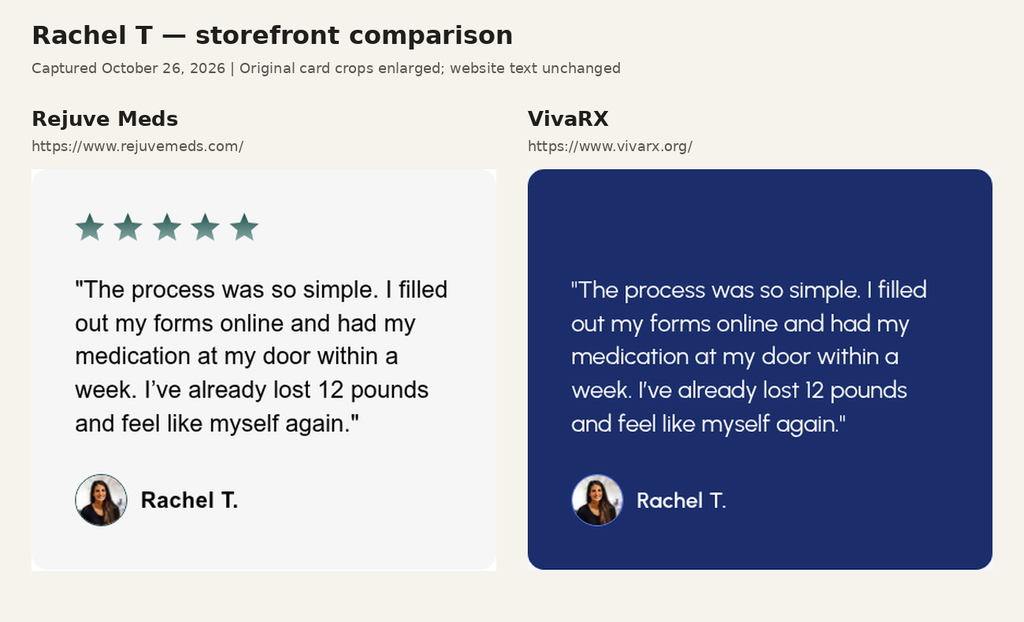
The testimonial sections on Rejuve Meds and VivaRX feature the same three names in the same order: Rachel T., Marcus L., and Sofia M. Each appears with the same accompanying photograph. Rachel’s account repeats the same details about completing forms, receiving medication within a week, and losing 12 pounds. Sofia’s account repeats the same praise for convenience, check-ins, and being able to message the team.
Marcus provides the most revealing comparison. His testimonial describes initial nervousness about an online medical program, followed by reassurance from the company’s team and provider. On Rejuve, he praises Rejuve Meds. On VivaRX, he praises VivaRX. The surrounding story and portrait remain the same. His gratitude has received a brand substitution.
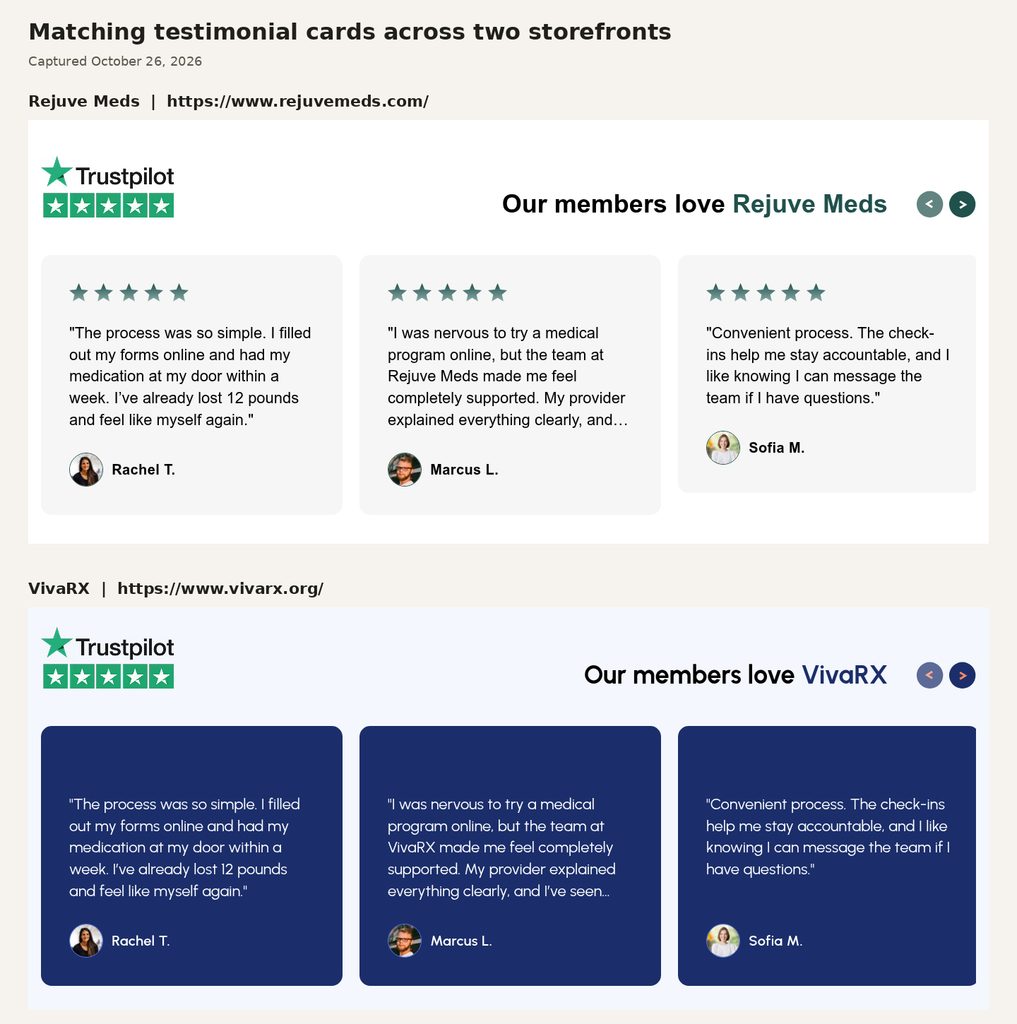
Rejuve Meds and VivaRX display the same three customer names and photographs. Rachel’s and Sofia’s testimonial wording repeats; Marcus’s changes the business name. Captured October 26, 2026.
That substitution matters because it changes what the endorsement is telling a prospective patient. Someone considering Rejuve is being shown praise for Rejuve’s care. Someone considering VivaRX is being shown praise for VivaRX’s care. Neither presentation explains, beside these cards, why the same named people and photographs are appearing in the other business’s testimonial section.
If these are shared patients, explain the relationship. If the testimonials were licensed or transferred, explain their origin and which service the people actually used. If they are demonstration content left in a template, stop presenting them as customer experience. The customer should not need to conduct a cross-domain investigation to discover what the endorsement is supposed to mean.
Three brands. Exactly 14,532 reviews.
The testimonial overlap is accompanied by another remarkably reusable achievement. The captured intake pages for VelvetRx, Rejuve Meds, and VivaRX all display the same total beside their branding and stars: 14,532 Reviews.
A number that precise communicates more than general popularity. It suggests somebody counted. A prospective patient could reasonably expect an identifiable collection of reviews, a defined business being reviewed, and some way to understand the rating. Instead, the same total appears under three different brands, without an explanation beside it identifying a shared review pool.
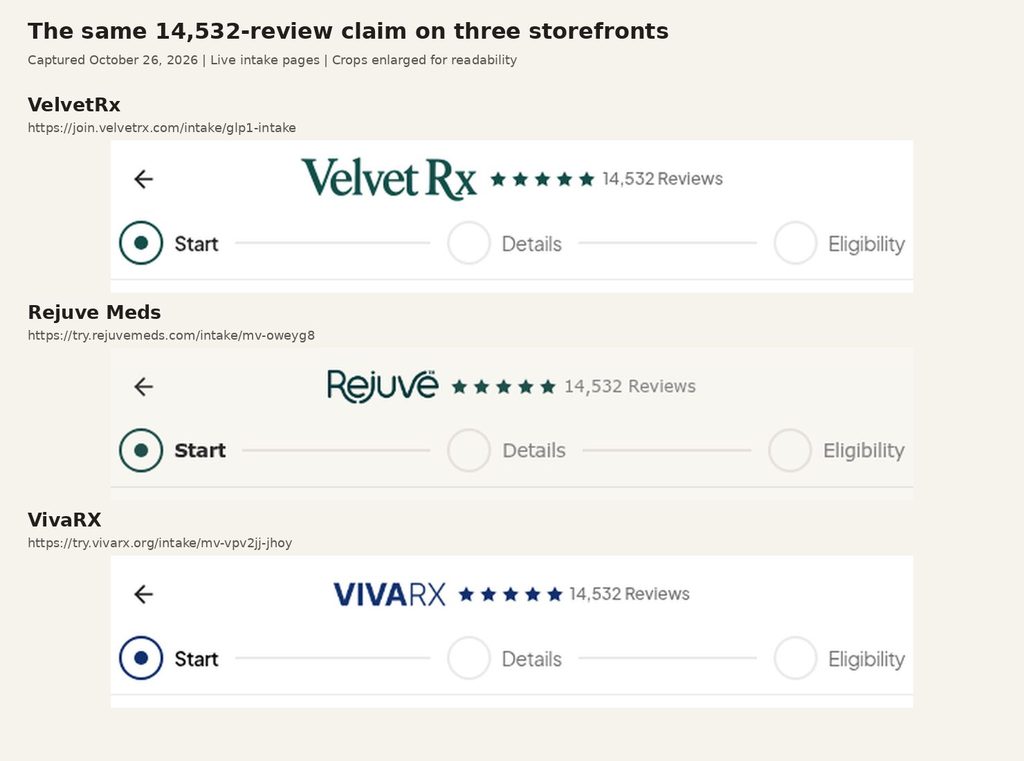
Three branded intake pages display the identical 14,532-review claim. The exact page URLs are printed above the captures. Rejuve’s captured page is its mv-oweyg8 funnel; its homepage also links to a different intake form.
The evidence is the repetition itself: three distinct branded presentations, one identical total. If that number belongs to a platform, a clinician network, an affiliated business, or an aggregate across merchants, say so where customers see it. Attaching a large number to a particular brand without explaining whose reviews are being counted gives that brand the benefit of a reputation the reader cannot meaningfully examine.
The specificity is doing sales work. Fourteen thousand reviews sounds established. The extra 532 makes it sound measured. Put five stars beside it and the whole arrangement arrives wearing a little laboratory coat of numerical authority.
The number is in the page. The review collection is still missing.
The returned HTML contains the same literal review-count element on all three captured intake pages. Our source comparison preserves that element exactly. It confirms that the number is part of the delivered page markup, alongside the matching visual presentation.
Identical review-count elements extracted from the three intake pages. This figure typesets the captured HTML for readability; it is not a browser screenshot.
An HTML excerpt establishes what the site delivered. Determining whether the application obtained that value from a database, a configuration field, or a fixed code constant requires tracing its implementation. The screenshot and source evidence already establish the immediate consumer-facing problem: the same unexplained total is being presented across three brands as a reason to trust them.
We have not identified a review collection corresponding to those three presentations. A visible number supplies no reviewer identities, dates, collection method, or account of what service was reviewed. Those are the missing receipts. Producing another attractive page with the same number would merely give the problem a fourth address.
Trustpilot branding makes the presentation more consequential
Both testimonial sections display Trustpilot branding near the customer cards. That placement matters. Trustpilot’s recognizable name and star imagery invite readers to associate the testimonials with an outside review service, even though the photographed cards are being presented on the merchants’ own websites.
Our captures document the placement and duplication. They do not establish that Trustpilot collected or authenticated these particular testimonials. That is precisely the distinction the websites should make clear. A recognizable review logo cannot perform the evidentiary work of linking a testimonial to its actual source.
The architecture of the pitch is easy to understand: a trusted-looking review mark, a customer photograph, a relatable account of weight loss, and a reassuring name. Together, these elements encourage a visitor to treat the business as experienced and credible. When the same package appears elsewhere with the company name swapped, the claimed personal experience starts looking like a reusable advertising asset.
The financial value of a borrowed reputation
For a medical storefront, trust is commercially valuable. Customers are deciding whether to share health information, proceed through an assessment, and pay for a service involving prescription treatment. A wall of apparent customer satisfaction can make those decisions feel less uncertain.
Authentic reputation takes work: serving patients, responding to problems, collecting feedback, and accepting that some of it will be unflattering. A copied testimonial section offers the visual benefits immediately. New colors, a different logo, a substituted company name, and the page can look as though satisfied customers have already done the due diligence for everyone else.
That is the incentive exposed by these comparisons. The photographs and stars make the storefront feel established before the visitor has examined who is behind it. The repeated material supplies a ready-made answer to the question every unfamiliar healthcare brand faces: why should anyone trust us?
The explanation belongs beside the claim
These businesses can answer straightforward questions. Where did the 14,532 reviews originate? Which organization received them? Why do the same named customers and photographs appear across the testimonial sections? Who changed the business name inside Marcus’s endorsement, and on what basis?
Until those questions are answered, the pages offer readers duplicated sales material where they should be offering traceable customer experience. The matching photographs are visible. The repeated wording is visible. The three identical review totals are visible. No amount of soothing wellness copy makes those comparisons disappear.
The next installment follows the shared platform behind these storefronts and examines how the websites are assembled. For now, the basic failure is already on the screen: prospective patients are being asked to trust a reputation whose presentation can be copied, recolored, and reassigned. Healthcare deserves better than a testimonial department run by Find and Replace.