The GLP-1 Website Factory — Part 3
Rimo pitches a shortcut into the telehealth business: bring the brand and the customers, and its platform supplies much of the machinery. Our investigation examines what happens when the reputation used to attract those customers appears to have been assembled with the same convenience.
The earlier installments followed the storefront claims. This one follows the infrastructure, the commercial incentives, and the certification process that was supposed to make the arrangement trustworthy. The question is how readily identifiable credibility problems survived inside a system that sells compliance assistance as part of getting merchants into business.
Three Certified Storefronts, One Rimo Backend
On October 26, 2026, our DNS checks found that join.velvetrx.com, try.rejuvemeds.com, and try.vivarx.org all pointed to cname.rimo.co. The three branded intake addresses converge on a common Rimo destination. Those records establish an infrastructure connection; the authorship of individual marketing claims requires separate records.
Our publisher, Ryan Dunn, also checked the three businesses’ certification claims and identified all three as LegitScript-certified. That makes them useful test cases for a straightforward proposition: whether the reassurance of certification corresponds to scrutiny of the pages patients actually encounter.
Rimo’s launch page advertises a typical two-week setup covering provider connections, pharmacy fulfillment, payments, intake flows, and certification assistance. It says more than 70 brands use its platform. That is Rimo’s own scale claim, and it makes the quality of its oversight consequential well beyond a single storefront.
Our findings concern these three businesses. Across them, the operational connection sits beside a pattern of repeated marketing claims. The necessary next question is where those claims originated and how they passed through the businesses and services involved. Calling each storefront a separate brand does not explain why its supposed reputation looks so interchangeable.
The Credibility Claims That Failed Basic Scrutiny
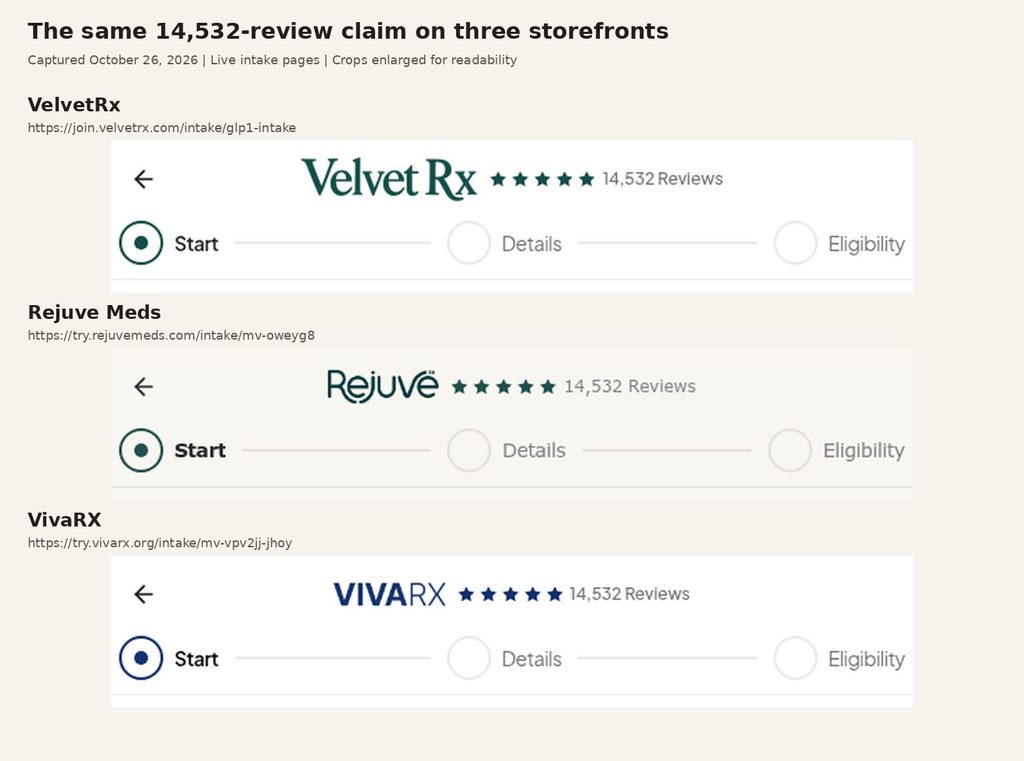
The captured intake pages for VelvetRx, Rejuve Meds, and VivaRX each displayed 14,532 Reviews. The number also appeared literally in their returned HTML. No traceable review collection or explanation of whose customers were counted accompanied the claim. Each storefront received the benefit of a remarkably specific reputation without providing its source.
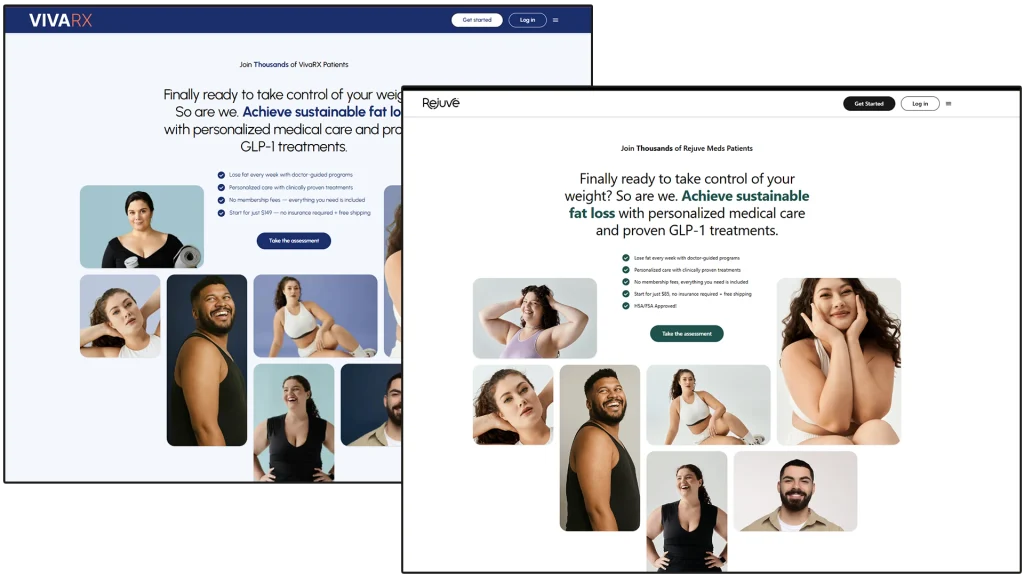
Rejuve and VivaRX also presented Rachel T., Marcus L., and Sofia M. with matching photographs. Rachel’s and Sofia’s accounts repeated across the sites. Marcus’s account changed which business received his praise. That manufactures the appearance of independent, brand-specific patient approval. Swapping the seller’s name in a testimonial does not create another satisfied patient.
Immediately below Rejuve’s homepage hero, a scrolling banner displays WebMD, Healthline, Forbes, Fortune, The New York Times, Fast Company, and Bloomberg. VivaRX carries the same banner. Several corresponding logos, including WebMD and Healthline, use identical asset filenames across the captured sites.

We have identified no verifiable connection or endorsement substantiating those displays. Inquiries are outstanding to determine whether an unpublished relationship exists. Meanwhile, the pages provide no clear explanation of what those organizations supposedly have to do with the merchants. Coverage of GLP-1 drugs generally would not establish an endorsement of either business. The familiar logos deliver the reassurance while leaving the relationship to the reader’s imagination.
VelvetRx’s Stanford display has a more definite answer: Stanford’s trademark group told our publisher there was no connection to VelvetRx. Stanford’s reputation was helping decorate a sales pitch for a business the institution disclaimed a connection with.

VelvetRx’s treatment-selection figures add artificial-looking precision. Our investigation found repeated, unchanged numbers presented as selections made “today.” The October 26 source contained 15,786 for semaglutide, 10,979 for tirzepatide, and 7,653 for oral GLP-1: 34,418 altogether. In that capture, the enclosing section was hidden by CSS, so these were values in delivered code rather than a visible live counter in our screenshots. A recycled daily claim requires dated transaction records to substantiate it.
The pattern spans several different forms of persuasion: numerical popularity, personal testimony, institutional prestige, and current demand. A patient encounters them together. Their cumulative effect is an appearance of established trust, even though the supporting evidence fails to appear alongside the claims.
Rimo Sells the Launch—and Disclaims the Screening
Rimo’s commercial offering starts at $2,500 a month, with consultation and processing charges separate. It says the merchant receives customer payments into its own account and pays Rimo separately. Its order workflow includes subscription billing and failed-payment retries. The system is organized to turn a customer relationship into recurring revenue.
That makes the material persuading someone to enter the system commercially important. Review totals and apparent endorsements help overcome hesitation before the patient reaches the intake or checkout. Rimo’s role in operating that process deserves examination alongside the merchant’s responsibility for what it says.
Rimo Health LLC’s terms state that it “does not pre-screen Materials.” They assign merchants responsibility for their content and compliance while reserving Rimo’s power to refuse or remove material. The platform therefore has an intervention mechanism, even as it declines to promise advance screening.
For the claims examined here, whatever diligence occurred failed the test. The copied endorsement and unexplained review total reached prospective patients. Assigning responsibility in a contract does nothing to substantiate them. Rimo cannot give a persuasive account of its compliance services without explaining how these elementary problems survived.
The merchant remains responsible for its claims. Rimo has its own questions to answer about the platform and assistance it sells. The relevant records should distinguish merchant submissions from shared content and show what review or removal decisions followed. Without that history, responsibility can be passed around indefinitely while the same presentation continues doing its commercial work.
LegitScript Is Part of the Commercial Package
Rimo describes itself as a LegitScript enterprise partner and advertises typical certification clearance in seven to fourteen days, subject to LegitScript’s independent timetable. Certification assists with eligibility for advertising and payments, while individual platforms retain their own requirements. It is a commercially valuable part of getting a telehealth brand into operation.
LegitScript’s enterprise program offers bulk pricing, prioritized processing, dedicated support, and co-marketing. It expressly describes partners bundling certification into their services or marking it up for profit. It also says referred applicants undergo the same process as other applicants.
The arrangement creates an obvious accountability issue. Certification is being sold inside a service designed to help businesses launch and grow. Its credibility depends on whether the scrutiny remains meaningful when a finding delays that commercial objective. The advertised process needs to be judged by the claims and products it actually allows certified businesses to present.
The written standard is clear. LegitScript’s healthcare certification rules require accurate, transparent, non-misleading practices and advertising. Scrutiny of a reassigned patient endorsement falls directly within that promise. So does determining what a review total represents.
In these test cases, certification coexisted with marketing that failed basic inspection. Calling the result a rubber stamp describes the practical role the badge played: it added a fresh layer of credibility to a presentation whose underlying claims remained unsubstantiated. The existence of an application process is a poor defense when the customer-facing result looks like this.
The CBS Response and the Retatrutide Problem
LegitScript’s response to the CBS investigation compounds the problem. As summarized by Camino Strategy Group, CEO Scott Roth said the businesses represented a small share of customers, had already been flagged through monitoring, and did not necessarily face immediate revocation.
That is a remarkably limp defense of a trust seal. A patient buying from one questionable seller receives no protection from the percentage of other clients the certifier considers satisfactory. An internal flag also does nothing for someone who encounters an unqualified badge. Saying the problem was already known makes that public reassurance harder to defend.
A remediation window needs a corresponding explanation for the people relying on certification. Otherwise, the merchant receives time to fix the problem while prospective patients receive the same comforting signal. The badge communicates certainty that the private review may no longer justify.
CBS reported that Rimo-hosted retatrutide questionnaires disappeared after inquiries to LegitScript.
The FDA’s position is explicit: retatrutide cannot be used in compounding under federal law and is not a component of an FDA-approved drug. The agency says the same about cagrilintide. Selling access to these substances as compounded treatment raises a much more serious issue than an inadequately sourced review widget.
LegitScript’s published peptide policy likewise prohibits certified businesses from offering, promoting, or advertising impermissible peptides. Using another entity for prescribing or dispensing does not provide a workaround. These are substantive restrictions on the activity connected to a certified business. A meaningful answer needs to explain how the restrictions are enforced while the public seal remains available to reassure customers.
The Products, the Approval Claims, and the Lawsuits
Rejuve advertises semaglutide oral tablets and tirzepatide oral tablets, describing them as dissolvable. VelvetRx places an FDA-approval claim above a treatment presentation that includes oral GLP-1 products. Those presentations require an exact explanation of which preparation the patient will receive and what approval, if any, belongs to it.
Compounded drugs are not FDA-approved. The agency has not reviewed those preparations for safety, effectiveness, and quality before marketing. Using an ingredient name associated with an approved medicine does not transfer the approved product’s status to another formulation.
Approved oral GLP-1 medicines exist, including Wegovy tablets. The approved Wegovy label instructs patients to swallow the tablets whole and not dissolve them. A compounded dissolving preparation does not become that approved product because its marketing also says semaglutide. The distinction belongs beside the product description, where it can inform the decision to buy.
The enforcement pressure is substantial. In August 2026, Eli Lilly announced six lawsuits against entities it accused of selling black-market retatrutide and called on platforms, payment companies, and regulators to intervene. In April 2025, Novo Nordisk reported 111 federal lawsuits across 32 states, alongside injunctions and judgments involving compounded-semaglutide marketing and sales.
Those companies have commercial interests in challenging competitors. Their allegations must be assessed on their evidence. Independently, the FDA restricts compounding copies of commercially available drugs, with the semaglutide and tirzepatide injection shortages resolved and patient-specific exceptions subject to actual requirements.
Lawful individualized compounding exists. A mass-market sales page does not establish that a particular transaction qualifies. Some disputes concern the boundaries of those exemptions; retatrutide’s compounding prohibition is explicit. Treating this entire market as comfortably legitimate because a seller displays a badge erases distinctions that matter to the treatment being supplied.
The appropriate explanation is product-specific: identify the preparation, the dispensing pharmacy, its approval status, and the basis for providing it. The merchant and the services supporting it should be able to connect those answers to the actual order. A broad assurance of compliance is no substitute for that chain of accountability.
The Records Rimo and LegitScript Owe
The next answers should come with documents. Rimo and the merchants should identify the source of the repeated marketing material and produce the records underlying the claims. LegitScript should explain how those claims were evaluated under its advertising and transparency standards.
For the three test cases, that means the review collection and its counting method; original testimonial submissions and an explanation of the brand substitution; the relationships behind the displayed logos; and dated records supporting the daily figures. The screening history should show what was checked, when problems were identified, and what corrective action followed.
The same accountability applies to product catalogs. A response should identify which products were reviewed and how changes after certification are monitored. That would allow the public to assess the substance of the checks, instead of being asked to take another assurance on trust.
Rimo advertises the ability to help brands launch at scale. LegitScript sells the confidence that accompanies certification. Our three test cases expose what happens when the impressive machinery runs ahead of the evidence. Until the records explain that failure, the badge remains part of the sales pitch—and the patient is left performing the diligence the system implies has already been done.