The GLP-1 Website Factory — Part 2
In the first installment of this investigation, we examined VelvetRx, a telehealth company apparently blessed with 14,532 customer reviews and 34,418 daily treatment selections that possess the supernatural ability to remain unchanged. Its website also prominently displayed Stanford Medicine branding despite Stanford denying any connection to the company.
We thought the review numbers were suspicious. We didn’t yet appreciate just how magnificent the underlying absurdity would become.
It turns out VelvetRx isn’t the only GLP-1 website claiming precisely 14,532 reviews. That same number appears on Rejuve Meds and VivaRX, two other businesses selling prescription weight-loss programs. More remarkably, Rejuve and VivaRX appear to have discovered a revolutionary advancement in customer satisfaction: the same customers can apparently have the same experiences, use the same photographs, and deliver the same testimonials for different companies.
Occasionally, the website operators even remember to change the business name.
This is not a matter of two businesses using similar marketing language. It is a documented collection of duplicated customer stories, identical underlying image files, repeated credibility displays, and shared medical-intake infrastructure. These websites aren’t merely borrowing inspiration from one another. Their customer testimonials appear to have been passed through a photocopier, given a fresh coat of paint, and sent back into the world pretending to represent independent experiences.
For companies selling medical treatment, that is one hell of a way to establish trust.
Meet Rejuve Meds and VivaRX: The Telehealth Identical Twins
Visit Rejuve Meds and you’ll encounter a polished weight-loss storefront complete with reassuring medical language, attractive product displays, impressive statistics, recognizable media logos, and testimonials from supposedly satisfied customers.
Now visit VivaRX.
The resemblance is extraordinary. The layouts are strikingly similar, the media-logo collections substantially overlap, many of the same images appear, and entire sections follow the same structure. One site uses a different color palette, some headings have been adjusted, and the company name has been changed.
It’s the medical-commerce equivalent of buying the same cheap Halloween costume in two different colors and insisting they’re entirely different superheroes.
Using common software or design templates is not inherently suspicious. Thousands of legitimate businesses use shared website platforms. But the problem begins when the interchangeable elements aren’t buttons, fonts, and layouts—they’re supposedly real human beings describing their personal medical experiences.
That’s precisely what our examination uncovered.
Rachel T.: Apparently a Customer of Both Companies
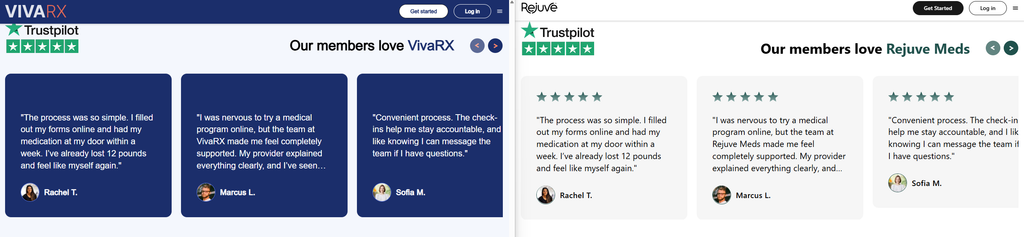
Both Rejuve Meds and VivaRX feature a testimonial attributed to a customer named Rachel T.
Rachel describes an easy online ordering process, medication arriving within a week, and losing 12 pounds. Her testimonial is accompanied by the same profile photograph on both websites.
Not a similar-looking woman. Not a photograph with vaguely comparable lighting or composition.
The same underlying image file.
The source-code records identify matching image-asset fingerprints across two separate Sanity content-management projects.
Here’s the relevant comparison:
| Detail | Rejuve Meds | VivaRX |
|---|---|---|
| Customer name | Rachel T. | Rachel T. |
| Reported weight loss | 12 pounds | 12 pounds |
| Testimonial text | Identical | Identical |
| Profile photograph | Same image | Same image |
| Image asset fingerprint | 105dcbcda9994f5e... | 105dcbcda9994f5e... |
What a fortunate coincidence. Two medical businesses somehow obtained the same photograph of the same woman describing the same weight-loss experience using precisely the same words.
A shared patient population could explain why a real person might have dealings with two related services. It does not eliminate the need to accurately identify which business provided the treatment being described.
But Rachel isn’t alone in this remarkable dual-brand loyalty.
She’s merely the opening act.
Marcus L.: One Patient, Two Medical Experiences, One Conveniently Rewritten Sentence
The Marcus L. testimonial is considerably more revealing because someone actually bothered to modify it.
On Rejuve Meds, Marcus describes initially feeling nervous about seeking medical treatment online. He credits the Rejuve Meds team with making him feel supported, says his provider explained things clearly, and reports seeing steady results.
On VivaRX, Marcus tells exactly the same story, using exactly the same language, accompanied by exactly the same photograph.
There’s just one tiny difference.
Where the Rejuve version says “the team at Rejuve Meds,” the VivaRX version says “the team at VivaRX.”
That’s it. The company name changes. The rest of the customer experience survives intact.
This is the point where an ordinary copy-and-paste website starts looking like a customer-testimonial production line.
A real patient’s account of receiving medical care is not supposed to function like a generic brochure template. You don’t get to swap one company’s name for another and assume the experience magically transfers with it.
Imagine a restaurant advertising a customer review praising its magnificent prime rib, then discovering that the identical review and customer photograph appeared on another restaurant’s website with only the establishment’s name changed.
Anyone with a functioning bullshit detector would demand an explanation.
Now replace prime rib with prescription medication, medical consultations, and compounded drugs.
Suddenly, the stakes are considerably higher.
A patient testimonial is supposed to document somebody’s actual experience. It is not a Mad Libs exercise for whoever operates the marketing dashboard.
If Marcus genuinely received treatment through both businesses, the companies can explain that relationship and document the authorization for the testimonials.
If the same patient record is being displayed across affiliated brands, that relationship should be disclosed accurately.
And if someone simply copied the testimonial and substituted the business name, the resulting advertisement raises obvious questions about whether the attributed customer experience is being represented truthfully.
The documents demonstrate the substitution. The companies owe customers an explanation of why it occurred.
Sofia M.: Apparently Nobody Thought Three Duplicates Would Be Suspicious
Then there’s Sofia M.
Sofia’s testimonial praises the convenience of the program, the accountability provided by check-ins, and the ability to contact the care team when questions arise.
Her story appears on both Rejuve Meds and VivaRX.
Same name. Same statement. Same photograph.
The image files again have matching asset fingerprints, despite appearing in separate CMS projects.
At this point, the coincidence explanation is starting to look like a man standing next to a shattered window holding a brick and insisting that meteorites are terribly common this time of year.
Three matching named customer testimonials. Three matching photographs. Two independently branded medical websites. And one testimonial in which the business name has been surgically replaced without disturbing the surrounding sentence.
The question isn’t whether the websites share creative assets. That is indisputable.
The question is whether the customers and their reported experiences have been represented accurately to the people being persuaded to purchase medical treatment.
Rejuve and VivaRX need to explain where these testimonials originated, what relationship the customers actually had with each business, and whether the underlying customers authorized the use and modification of their words and photographs.
Until then, the testimonial sections deserve to be treated as marketing claims requiring verification, not reliable evidence of genuine customer satisfaction.
The Trustpilot Costume: Put a Famous Logo Above Your Own Testimonials and Call It Credibility
Now we arrive at one of the most brazen-looking features of the entire presentation.
Both Rejuve Meds and VivaRX display a prominent Trustpilot logo above their testimonial sections.
To a casual visitor, that placement suggests the displayed customer stories have some connection to Trustpilot’s independent review platform. It’s an enormously convenient association: a familiar review brand hovering over a collection of glowing endorsements.
But when we examined the underlying HTML, we discovered something rather different.
Both websites load the Trustpilot branding as a separately uploaded image asset. The testimonials themselves are rendered through custom website carousel components, with their own images, names, and statements embedded in the sites’ content.
We did not identify those sections as official, live Trustpilot review widgets retrieving the featured testimonials from Trustpilot.
And when we checked Rejuve Meds’ actual Trustpilot profile, the discrepancy became almost comical.
<escape>
Rejuve Meds’ public Trustpilot profile showed just **three reviews** and a **4.0 TrustScore** during our October 2026 investigation.
</escape>
Three.
Meanwhile, its medical-intake page advertises 14,532 reviews alongside five filled stars.
The website’s Rachel, Marcus, and Sofia testimonials are not among the three reviews listed on Rejuve’s public Trustpilot profile.
Those reviews may have originated somewhere else. But if that’s the case, what precisely is Trustpilot’s logo doing prominently displayed above them?
Trustpilot’s own September 2026 Brand Guidelines address this precise kind of presentation.
The rules govern authorized use of its brand assets and review displays. They require accurate representation of reviews and ratings, restrict alterations to reviewer statements, and prohibit unauthorized or misleading widget implementations.
The guidelines also require businesses using Trustpilot review quotations in their marketing to respect the original wording, properly identify the reviews, and obtain appropriate permission for identifiable reviewer photographs.
One wonders how those requirements square with a testimonial that changes the name of the medical business while retaining the customer’s photograph and remaining words.
Trustpilot is an independent review platform. Its logo is not supposed to be a decorative sticker that can be slapped onto an arbitrary collection of glowing testimonials to make them appear independently validated.
Yet that’s the impression these pages risk creating.
The Trustpilot logo isn’t a baptismal font. Dunking a testimonial beneath it doesn’t wash away questions about its authenticity.
The Website Source Code Is an Unusually Talkative Witness
We didn’t discover these similarities by squinting at two websites and guessing.
We examined the underlying HTML and application data.
The Rejuve and VivaRX homepages use separate Sanity CMS projects:
| Website | Sanity project |
|---|---|
| Rejuve Meds | irzk7otd |
| VivaRX | d0kf35tk |
Despite the separate content repositories, their matching customer photographs retain identical content-derived image identifiers.
The Rachel image has the same fingerprint on both websites. So do Marcus and Sofia. This strongly establishes that the same image assets were copied between the sites, not independently created for each business.
The source also contains a wonderfully embarrassing leftover on the VivaRX homepage.
An image is still described as:
“When nothing else worked… Rejuve Meds did.”
On VivaRX’s website.
Apparently, somebody managed to change the colors, alter the company name, reconfigure the products, and republish the customer testimonials but forgot to finish laundering the source branding from every asset.
The abandoned reference is especially telling because it reveals the relationship at a level ordinary website visitors would probably never notice.
The cloning isn’t confined to superficial design similarities. It extends into content assets, image descriptions, and customer endorsements.
And that’s before we get to the medical-intake system.
The 14,532-Review Number Returns Like a Bad Penny
As documented in Part 1, VelvetRx’s intake claims precisely 14,532 reviews.
Rejuve Meds claims precisely 14,532.
VivaRX claims precisely 14,532.
All three intake experiences use the same underlying application software, and the review display uses the same presentation structure.
The rendered number is present directly in the delivered HTML. We did not find an identifiable underlying collection of 14,532 reviews supporting the claim on any of those intake pages.
Rejuve and VivaRX have a technical relationship that could explain some shared data: VivaRX’s intake configuration references Rejuve’s underlying store account.
But VelvetRx operates through a separate store account.
So why does it get the same magical review total?
Does 14,532 belong to Rejuve? VelvetRx? VivaRX? The software provider? All of them? None of them?
It’s an astonishingly specific numerical claim to be floating around the internet without an identified source.
A genuine review-count system should have records. Reviews should have dates, authors or customer identifiers, corresponding transactions or experiences, and a collection process.
A software template, by contrast, needs only a number.
The fact that the number appears in HTML tells us how it’s displayed. The suspicious part is that multiple separately branded businesses display the same impressive figure without identifying whose reviews they’re counting.
It is difficult to imagine a more effective way to make an inexperienced medical storefront look established than placing five stars and a five-digit review count directly above its patient-intake form.
Which is precisely why the provenance of that number matters.
The FTC’s consumer-review rules prohibit specified fake and false testimonials, including misleading representations of experiences with businesses or products. The FTC’s guidance also makes clear that businesses distributing false testimonials in their own advertising are not simply passive hosts of third-party content.
Whether a particular advertisement violates those rules depends on the underlying facts. But the duplicated evidence here is exactly the kind of material that deserves scrutiny rather than automatic acceptance.
A Medical Website Factory With a Few Assembly-Line Mishaps
The cloning extends into the medical sales copy.
VivaRX’s homepage advertises an Ozempic injection while describing it as containing the same active ingredient as Mounjaro and Zepbound.
That is wrong.
Ozempic contains semaglutide. Mounjaro and Zepbound contain tirzepatide.
Those are different active ingredients.
This is not a minor disagreement about the best wording for a marketing slogan. It is a basic factual distinction between prescription medications.
And yet the incorrect product description appeared on a website selling medical weight-loss treatment.
It’s almost as if the product cards were assembled from interchangeable pieces without anyone stopping to check whether the medication names matched the substances being described.
That error belongs to VivaRX’s own site, not to every business using the same underlying software. But it illustrates why aggressive template reuse in healthcare requires actual medical and editorial oversight.
The customer experience begins with a slick, reassuring website. The business wants the visitor to believe that competent medical professionals are overseeing the process.
That confidence becomes somewhat harder to maintain when the public-facing material cannot reliably distinguish semaglutide from tirzepatide, contains another company’s name in its image descriptions, and features customers whose testimonials have been repurposed across brands.
Beautiful gradients, fashionable typography, and reassuring phrases about physician-led care cannot compensate for a failure to get elementary medical facts right.
The Shared Infrastructure Leads to Rimo Health
Following the technical trail revealed the company operating the underlying medical-intake software: Rimo Health.
The intake domains for VelvetRx, Rejuve Meds, and VivaRX all point to Rimo’s infrastructure through the same DNS destination, cname.rimo.co.
Their forms share a common application architecture designed to support different branded medical storefronts.
Rimo markets itself as a white-label telehealth platform. It supplies or coordinates much of the machinery needed to operate an online medical-commerce business, including intake questionnaires, patient portals, licensed-provider routing, pharmacy fulfillment integrations, subscription billing, and support for obtaining healthcare advertising certification.
The business model is straightforward: customers can launch their own branded telehealth operations without independently constructing every piece of the underlying technology.
Nothing about that arrangement requires fake reviews or misleading testimonials. White-label platforms can support legitimate businesses.
But shared software also makes it possible for the same marketing components and configured content to appear across otherwise distinct brands. When the repeated element is a button, nobody cares. When it is a claimed 14,532 customer reviews, everyone should care.
And when separately branded homepages recycle the same named patient testimonials, photographs, and statements, the need to identify the person responsible for those representations becomes unavoidable.
Rimo’s published Terms of Service state that it does not pre-screen materials submitted by merchants and places responsibility for customer-facing content and regulatory compliance on those merchants.
That contractual arrangement is remarkably convenient for the platform, but it doesn’t answer who built the shared review component, who supplied the repeated count, or whether platform operators knew it was appearing across different businesses.
Those questions deserve direct answers from Rimo, Rejuve, VivaRX, and VelvetRx.
The fact that a website can be launched rapidly is impressive technology. The ability to reuse another company’s patient testimonials should not be mistaken for an equally impressive medical innovation.
Why the Same Patients Matter More Than the Same Website Design
There’s an important distinction at the heart of this investigation.
Reusing a website design is normal.
Reusing product-page structure is normal.
Even using the same physician network or pharmacy fulfillment provider can be perfectly legitimate, provided the relationships are disclosed accurately and the medical and legal requirements are satisfied.
Reusing the same customer’s claimed medical experience under two different business names is something else entirely.
A testimonial is not simply decorative text. It is offered as evidence that an actual person interacted with a particular business, received a particular service, and experienced a particular result.
That is the whole reason testimonials are valuable.
A prospective patient doesn’t see Rachel, Marcus, or Sofia as generic website illustrations. The reader sees apparent evidence that other people trusted the company and benefited from its care.
The business is borrowing those people’s supposed experiences to persuade a new customer.
When the same experiences are republished under different businesses, the company has an obligation to ensure the attribution remains truthful.
Otherwise, the advertising becomes a bizarre exercise in manufacturing personal credibility from reusable content.
And when that presentation is paired with a Trustpilot logo, the potential for confusion becomes even greater.
The real questions are whether these are actual patients, which organizations treated them, whether they authorized the publication of their testimonials, and why the stories appear under different company names.
Three photographs and three paragraphs of marketing copy should not require a federal grand jury to explain.
The Companies Have Some Very Specific Questions to Answer
Rejuve Meds and VivaRX should identify the original source of the Rachel T., Marcus L., and Sofia M. testimonials. They should explain whether the individuals are genuine customers, which organization provided their care, who authorized use of the photographs, and why Marcus’s statement was modified to identify a different business.
They should also explain whether the featured testimonials were ever published on Trustpilot, whether the Trustpilot-branded displays are authorized, and how those displays correspond to the companies’ actual public Trustpilot records.
Rejuve, VelvetRx, and Rimo should identify the source of the 14,532-review figure appearing across their intake experiences. They should explain the number’s collection period, ownership, verification process, and relationship to the different brands displaying it.
These are not outrageous demands from an unreasonable critic.
They are basic questions about advertising representations made to people considering prescription medical treatment.
The more remarkable question is why the companies apparently felt comfortable publishing these materials without making their origins obvious to consumers in the first place.
A Five-Star Reputation Shouldn’t Come Out of a Photocopier
The most damning part of this investigation isn’t that Rejuve Meds and VivaRX look alike. That’s merely the wrapping paper.
It’s that their customer stories look alike because they are the same stories.
Their customer photos look alike because they are the same files.
One supposedly independent testimonial praises a different business depending on which website you’re visiting.
Both sites wrap their testimonial sections in familiar Trustpilot branding, while Rejuve’s independently accessible Trustpilot profile contains only three public reviews.
And the broader collection of related intake forms somehow continues to display the same enormous 14,532-review total.
At some point, the phrase social proof starts sounding less like a marketing principle and more like an instruction manual for building an artificial reputation.
A genuine medical business should have actual patients, actual medical records, actual customer experiences, and actual documentation supporting its advertising.
It shouldn’t need interchangeable identities, recycled endorsements, or mystery review counts to persuade customers that it’s trustworthy.
The companies may have explanations for every one of these discrepancies. They are welcome to provide the underlying documentation.
But until those explanations are available, the websites’ credibility presentations have earned precisely what their operators probably hoped to avoid: scrutiny.
If a customer testimonial can switch medical providers with a find-and-replace operation, it’s not the customer’s treatment that’s being personalized. It’s the advertisement.
And the strangest part is that this isn’t merely a tale about a couple of copycat websites.
The same technical investigation leads to a platform designed to manufacture the operational infrastructure of telehealth brands on demand. A system in which the customer-facing company may be only one layer in a much larger commercial arrangement.
That company is Rimo Health.
In Part 3, we’ll examine the business behind the software, the people running it, its healthcare and pharmacy relationships, and its role in helping new medical storefronts obtain the certification needed to advertise online.
Because as absurd as the copy-and-paste patients are, the machinery behind them is an even bigger story.
About This Investigation
This is Part 2 of RippedMeOff’s investigative series, The GLP-1 Website Factory.
The findings are based on public website content and HTML captured in September and October 2026, including examination of Rejuve Meds and VivaRX testimonial text, matching Sanity CMS image identifiers, their intake-platform configurations, and public Trustpilot records.
Matching images and duplicated wording establish reuse of the same material. The records reviewed do not independently establish whether the named testimonial subjects are real patients or which organization originally collected the statements. The businesses are invited to substantiate the representations.
Sources and Documentation
- Rejuve Meds — Official Website
- VivaRX — Official Website
- Rejuve Meds — Patient Intake
- VivaRX — Patient Intake
- VelvetRx — Patient Intake
- Rejuve Meds — Public Trustpilot Profile
- Trustpilot — September 2026 Legal Brand Guidelines
- FTC — Consumer Reviews and Testimonials Rule
- Rimo Health — White-Label Telehealth Platform
- Rimo Health — Terms of Service