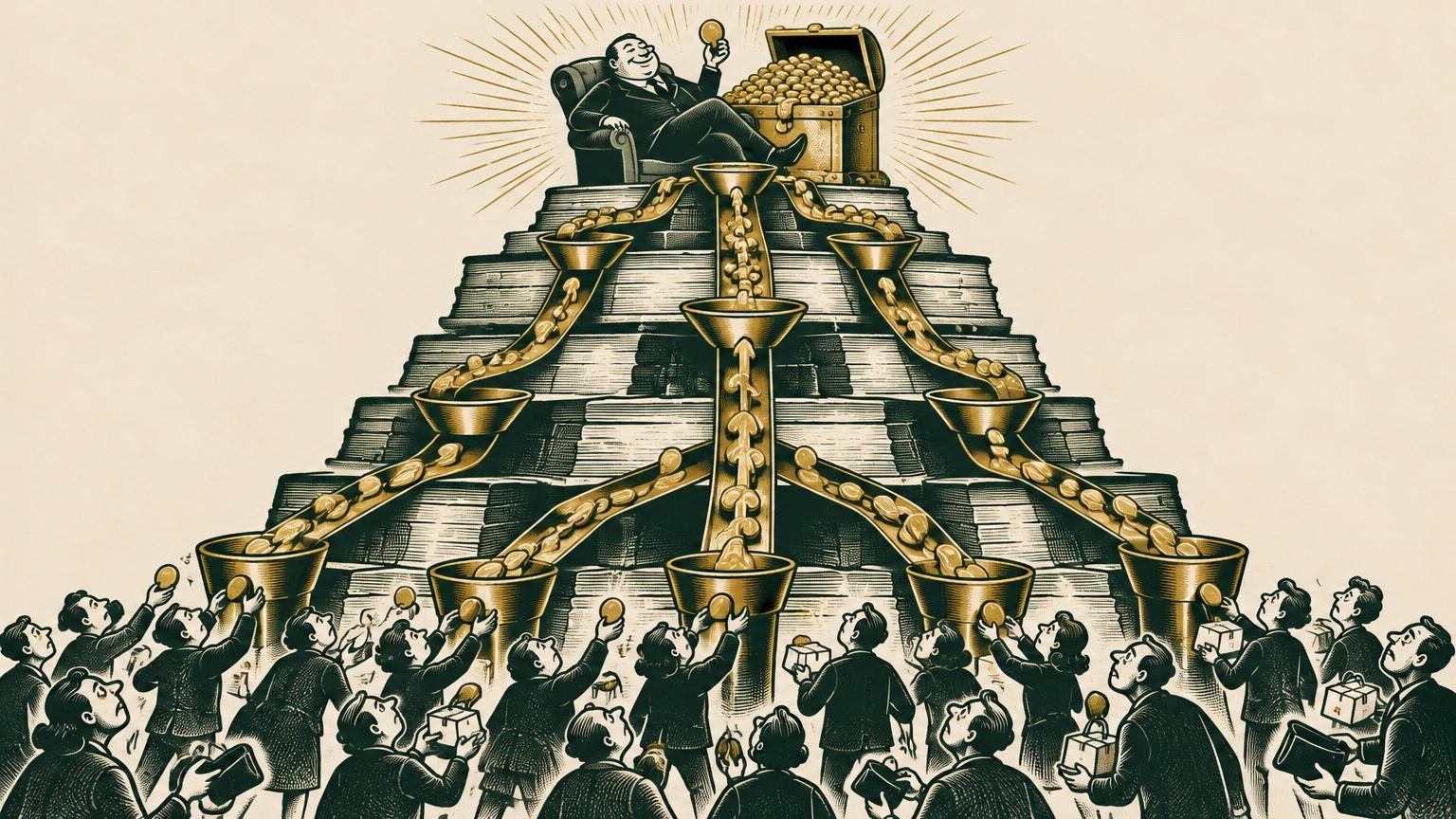
An MLM compensation plan is a staircase built out of other people’s purchases. Money enters at the bottom through a customer order, a distributor order or some monthly scramble to remain qualified. The company takes the sale. A portion may become retail margin or commission. Smaller portions can then climb through sponsors, groups, generations and leadership ranks, shedding complexity like a squid firing ink at an auditor.
The sales pitch usually concentrates on possibility: build a team, help people, unlock bonuses, become the sort of person who poses beside a rented sports car while discussing “time freedom.” The financial machinery is less spiritual. Somebody buys a product. The company records sales volume. Participants who have satisfied the right collection of personal-volume, customer-count, group-volume and rank conditions receive slices calculated under the plan. Everyone else gets the character-building experience of having generated volume.
That is how multi-level marketing compensation plans work in their purest economic form: purchases happen broadly, but meaningful rewards depend on qualification and position. The products may be perfectly real. So are the invoices. The interesting question is how much of the resulting cash stays with ordinary participants and how much value migrates toward the company and the comparatively small population occupying qualified positions higher in the structure.
The first stop is always the company cash register
Whether the buyer is an outside customer or a distributor, the company sits at the first tollbooth. It sets the retail price, wholesale or member price, commissionable value, volume points, qualification rules and bonus schedule. It also decides that a dollar can become three points, seven acronyms and a spiritually significant title before anybody is allowed to call it income.
Not every purchase is economically identical. A genuine retail customer buys because the product is wanted. A distributor may buy for personal use, resale, samples or the volume needed to qualify for compensation. Enrollment itself does not necessarily produce a commission, but a newly enrolled participant can become a new source of orders, customer registrations and downline volume. Recruitment matters because it can enlarge the pool of purchasing and selling activity beneath an upline.
The Federal Trade Commission’s MLM business guidance says legality depends on how a plan operates in practice and what incentives it creates—not merely whether real products exist or the company labels payments “sales compensation.” Regulators examine whether participants are pushed to recruit, purchase regularly or make large purchases to remain eligible. Compensation in a lawful MLM must be based on sales to ultimate users, but the mere presence of retail customers is not a magical corporate absolution booth.
A purchase can feed several mouths
A typical order can support several economic claims at once. The company receives revenue. A direct seller may retain the difference between the customer price and the participant price. The sponsor may receive a first-level payment. A qualified representative may earn a group-volume bonus. Leaders farther above may receive team or generation bonuses. This does not mean every sale pays every person, nor that published percentages can simply be added together. Different bonuses may use different bases, qualifications and internal point systems.
| Stage | Who supplies or controls the value | What can happen |
|---|---|---|
| Order | Retail customer or participating distributor | Cash reaches the MLM company and the order generates whatever sales volume the plan recognizes. |
| Retail margin | Direct seller | The seller may keep the spread between a discounted participant price and the customer price. |
| Level bonuses | Sponsor and qualified uplines | A percentage based on commissionable sales or business volume may be paid if personal and group requirements are met. |
| Rank qualification | Distributor and downline organization | Customer counts, personal volume, group volume and organizational structure determine which bonuses remain unlocked. |
| Leadership bonuses | Higher-ranked uplines | Additional group, team, generation or override payments may extend through several layers. |
| Expenses | Participant | Product, events, travel, tools, samples, marketing and other costs reduce whatever payment was received. |
Imagine a generic $100 order—not a representation of any named company’s payout. The company collects the $100. It may recognize only part of that amount as commissionable value. The direct seller may receive a retail spread, while one or more qualified uplines receive bonuses calculated from that smaller internal base. If the seller fails a customer-count or volume condition, some potential bonuses disappear. If an upline has qualified, the order still helps that upline’s group. The money does not literally climb a ladder dollar by dollar; the order supplies the volume from which the plan calculates who has earned a bucket.
The genius is almost indecent. The participant can perform the least glamorous part—finding a buyer, placing an order or maintaining activity—while the compensation formula reserves its warmest embrace for people who have already assembled qualifying organizations. It is capitalism redesigned as a wedding cake: lots of structural weight at the bottom, tiny decorative humans at the top.
Nu Skin’s plan shows the overlapping machinery
Nu Skin’s U.S. Sales Performance Plan, effective May 1, 2026, distinguishes unregistered customers, retail customers, Members and Brand Affiliates. Customers cannot recruit or resell. Brand Affiliates can buy at Member Price, register customers and affiliates, sell products and pursue representative status. The stated Retailing Bonus is the difference between the retail customer price and Member Price.
The same plan then adds layers. A Brand Affiliate in good standing can receive 5% of Commissionable Sales Value, or CSV, on first-level sales volume. A 5% second-level CSV bonus requires at least 500 Level 1 Sales Volume during the month. Brand Representatives reaching 3,000 Group Sales Volume can receive an additional 5% on the first two levels, while a Building Bonus ranges from 10% to 25% of CSV on Group Sales Volume, beginning at 2,000 GSV and reaching the top stated rate at 15,000 or more.
Above that sits the Leading Bonus for Gold-or-higher representatives. It pays 5% of Team CSV plus another 5% on the Group Sales Volume of personally registered first-generation representatives. Eligible generations expand with title, from the first generation at Gold to the sixth at Blue Diamond. One qualifying purchase can therefore contribute to a direct seller’s margin, sponsor-level calculations, group bonuses and leadership calculations. But CSV is Nu Skin’s internal commission basis, not the retail price, so stacking every advertised percentage into one giant payout figure would be mathematical fan fiction.
Qualification is where the velvet rope appears. Initial Brand Representative qualification requires either 3,000 GSV with 1,000 Level 1 SV in one month or a multi-month route totaling 4,000 GSV with monthly minimums. Maintenance generally requires 2,000 GSV each month. Apart from Retailing Bonuses, participants must also have sales to five different customers or unregistered customers each month to qualify for bonuses. Flex Points can preserve title in limited circumstances, but they do not restore eligibility for Double Level 1/2, Building or Leading Bonuses that month. If representative status is lost, the network moves up a generation into the networks above.
That last feature makes the incentive especially clear. Rank is not merely a commemorative sash. It governs access to money and the position of an organization. Qualification rules encourage participants to keep customer activity and group volume moving because stalled volume can shut bonus doors. The company benefits from recurring sales. Qualified leaders benefit from productive depth. The person staring at a monthly threshold benefits mainly from discovering how many moisturizers can fit inside a hall closet.
Published percentages are not published prosperity
Nu Skin states that average monthly sales compensation paid to U.S. Active Brand Affiliates in 2024 was $178.35 before expenses. It also says an average 21.58% of U.S. Active Brand Affiliates received a sales-compensation payment in a given month. That figure is neither average net profit nor the outcome for every enrollee. It describes company-paid compensation to a defined active population before the participant’s costs perform their usual mugging in the parking lot.
Nu Skin’s 2025 annual filing reported $1.49 billion in total revenue and core Nu Skin selling expense equal to 40.3% of revenue. The company says that expense category includes varied compensation and incentive-program components driven by sales-leader performance, so it should not be mistaken for a clean distributor-commission total. Even the company’s customer count includes sales-force members who purchased directly from Nu Skin while excluding consumers who bought from sales-force members. “Customer” can therefore be an accounting category with more costume changes than a touring musical.
Amway’s disclosure reveals the altitude problem
Amway’s 2025 U.S. income disclosure says 38% of U.S. Independent Business Owners had no reported product sales, sponsored no other IBO and received no payment from Amway. Fifty-nine percent received a payment in at least one month for product sales occurring during the year. Among those who received at least one payment, the top half averaged $3,598 in annual earnings before expenses, while the median was $551. For the top 10% of payment recipients, the average was $15,691 and the median was $4,854, again before expenses.
Amway recognition levels depend on personal and downline volume. Its published material describes a monthly group-volume performance-bonus scale beginning at 3% for 250 to 899.99 PV and reaching 21% at 12,500 or more PV. Its Silver description requires at least one performance-year month qualifying for a 25% performance bonus on personal volume. The disclosure lists 0.19% of all IBOs at Silver, 0.11% at Gold, 0.18% at Platinum and 0.54% at Founders Platinum.
Those numbers expose the basic architecture. A plan can advertise substantial bonus rates without those rates describing the typical participant’s result. The eye is invited to admire the penthouse percentages; the income disclosure quietly shows how few people possess the elevator key.
Herbalife shows why verified retail sales matter
In 2016, Herbalife settled FTC charges, agreed to restructure its U.S. operations and agreed to pay $200 million for consumer redress. The FTC alleged that the pre-settlement structure rewarded recruiting and purchases made to advance in the plan rather than actual retail demand. The order required at least two-thirds of rewards paid to U.S. business-opportunity participants to be based on tracked, verified retail sales, with no more than one-third tied to limited personal consumption.
Herbalife’s 2024 annual filing says a U.S. member does not receive Volume Points until product is sold to a customer at a profit and specified sales information is collected. Outside the United States and China, members generally accumulate Volume Points when they purchase product from the company. The filing also describes distributor allowances of up to 50%, royalty overrides up to 15%, production bonuses up to 7% and a Mark Hughes bonus of about 1%. These are components and ceilings, not a promise that every shake-slinging optimist receives the full buffet.
The distinction between verified retail demand and participant purchasing is not bookkeeping trivia. It asks who truly wanted the product and why the transaction happened. When compensation eligibility depends on volume, internal purchases can look economically useful even when outside demand is weak. Verification forces the plan to demonstrate that rewards are connected to actual end-user sales rather than boxes migrating into distributors’ garages for the annual nesting season.
Income disclosures can make zero disappear
The FTC’s 2024 staff report on 70 MLM income disclosures found that, where the available data allowed calculations, many participants received no payments and the vast majority received $1,000 or less annually—under $84 per month. The report also found that disclosures often omitted expenses or downplayed people who earned nothing. A payment from an MLM is not profit when product purchases, travel, events, marketing materials, tools, training and other operating costs are still chewing through the participant’s bank account.
Denominators perform some of the industry’s finest stage magic. Exclude people who earned nothing, failed to qualify, left quickly or were classified as inactive because they received no compensation, and the remaining average begins to look healthier. It is the financial equivalent of judging a ship’s safety record after removing everyone who drowned from the passenger list. The FTC specifically warns that such exclusions can mislead readers about typical outcomes.
Independent survey evidence points in the same grim direction, although it cannot establish outcomes at every company. An AARP Foundation survey of 601 current and former MLM participants reported that 47% lost money, 27% broke even and 25% made a profit over their participation. Only three respondents, or 0.5%, reported profits of $100,000 or more.
Who wins, who pays and why the structure persists
The company wins first because it controls the products, prices, volume system and qualification gates while receiving revenue from recognized orders. Active sellers can win through retail margins and direct bonuses. Qualified leaders can win more substantially because they may receive payments tied to group, team or generational activity. Participants with insufficient retail demand, weak organizations or lapsed qualifications can supply sales volume without unlocking much compensation at all.
The arrangement persists because its incentives are brutally efficient. Growth recruits new sales effort and potential purchasing activity without requiring the company to build a conventional salaried retail workforce of equal scale. Rank requirements encourage recurring production. Downline volume gives leaders a reason to train, motivate and retain participants. Aspirational titles turn thresholds into status. Income disclosures then report gross payments before expenses, while the sales presentation points lovingly toward exceptional outcomes in the distant atmospheric layer.
The money trail is therefore not mysterious. Dollars enter through product orders. The company collects them. The plan converts selected sales into volume and routes compensation according to retail margins, sponsorship, group production, rank and leadership depth. Expenses remain with participants, and the largest advertised rewards wait behind requirements most participants never reach. The ladder pays well at the top because the bottom is broad, busy and paying. That is not entrepreneurial magic. It is an upward cascade wearing a name badge and shouting about freedom.
Frequently Asked Questions
What determines who receives MLM commissions?
The plan’s rules do. Personal sales, customer counts, personal volume, group volume, rank and downline structure can all decide whether a purchase unlocks compensation or merely becomes another useful brick in somebody else’s staircase.
Can the advertised bonus percentages simply be added together?
No. Different bonuses can use different internal values, eligibility rules and organizational levels. Nu Skin, for example, calculates several payments using Commissionable Sales Value rather than retail price, so adding every headline percentage produces mathematical fan fiction.
Are MLM income-disclosure figures the same as profit?
Usually not. Disclosures may report company payments before product, travel, events, tools, training, marketing and other costs have taken their bite. The FTC also found that disclosures often omitted expenses or downplayed participants who earned nothing.
Why do verified retail sales matter?
They show that products reached actual end users rather than merely generating qualification volume inside the network. The Herbalife settlement required most U.S. participant rewards to be based on tracked, verified retail sales after the FTC challenged incentives tied to recruiting and advancement purchases.
Who benefits most from the MLM payment structure?
The company collects revenue and controls the volume system. Active sellers may earn retail margins or direct bonuses, but qualified leaders can receive payments tied to larger groups, teams and generations. Participants who miss the gates can still generate volume while receiving little or nothing.
References
- www.nuskin.com
- 2025 U.S. Income Disclosure
- Definitions of PV and BV – Amway MSB
- Multi-Level Marketing Income Disclosure Statements
- Business Guidance Concerning Multi-Level Marketing | Federal Trade Commission
- www.sec.gov
- Herbalife Will Restructure Its Multi-level Marketing Operations and Pay $200 Million For Consumer Redress to Settle FTC Charges | Federal Trade Commission
- 10-K
- AARP Study of Multilevel Marketing